Karolinum Press, Charles University
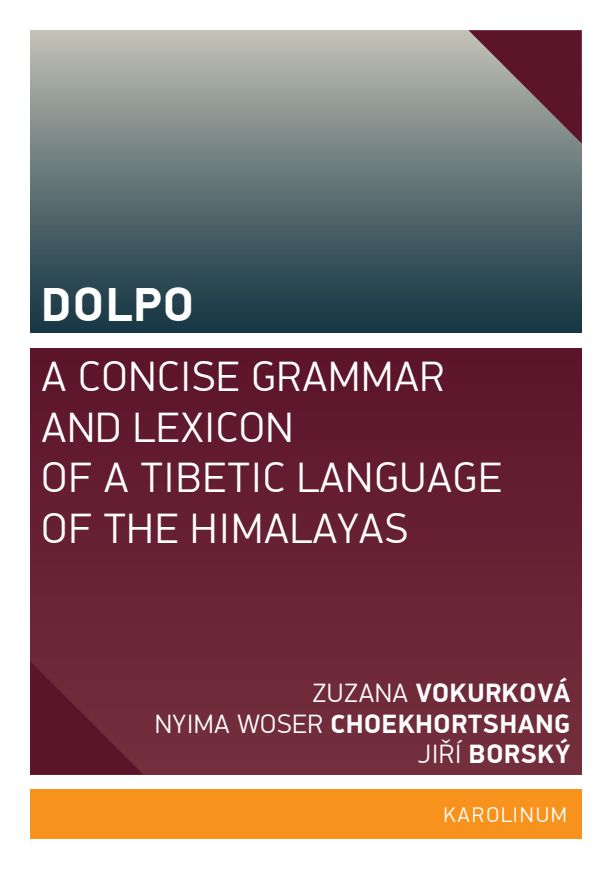
Dolpo
A Concise Grammar and Lexicon of a Tibetic Language of the Himalayas
Distributed for Karolinum Press, Charles University
Dolpo
A Concise Grammar and Lexicon of a Tibetic Language of the Himalayas
An invaluable resource about the Tibetic language of Dolpo.
Dolpo is a Tibetic language spoken in the Dolpo region of northwestern Nepal in the Himalayas. The introductory chapters of Dolpo are devoted to the geographical, anthropological, and linguistic characteristics of the language and its phonology. The core of the book is a description of the main grammatical categories of Dolpo, focusing on the issue of word order, the system of case markers, nouns and pronouns, verbs, evidential and epistemic categories, the system of verb tenses and aspects, negation, interrogative sentences, clitics and compound sentences. The book includes a Dolpo-Tibetan-English lexicon containing approximately 1,000 frequently used vocabulary items.
170 pages | 14 halftones, 65 tables | 6.38 x 5.12 | © 2026
Asian Studies: South Asia
Language and Linguistics: General Language and Linguistics, Language Studies


Table of Contents
Preface
Main outputs
Methodology
Field research, data, and consultants
Structure of the monograph and examples
Writing system for Dolpo
1. Introduction
1.1 Geographic and administrative characteristics16
1.1.1 The Dolpa District
1.1.2 Dolpo
1.2 Anthropological and social characteristics
1.2.1 Population of Dolpopas
1.2.2 Historical accounts
1.2.3 Religion
1.2.4 The economic situation and contemporary Dolpo society
1.3 Linguistic characteristics
1.3.1 Classification of the Dolpo language
1.3.2 Dolpo varieties
2. Phonology
2.1 Consonants
2.1.1 Voicing
2.1.2 Fricatives and affricates
2.1.3 Sound correspondences between Dolpo and Classical Tibetan
2.2 Vowels
2.2.1 Evolution of umlauts
2.2.2 Nasalized vowels
2.2.3 Diphthongs
2.3 Minimal pairs
2.4 Phonological changes
2.4.1 Vowel assimilation
2.4.2 Consonantal modifications in an intervocalic environment
3. Word order and case marking
3.1 Grammatical and Semantic roles
3.2 Nominal case markers
3.2.1 The genitive marker ???? /-kyi/
3.2.2 The agentive marker ????? /-kyi:/
3.2.3 The dative marker ??? /-le/
3.2.4 The ablative marker ??? /-ni/
3.2.5 The associative markers ??? /-rang/ and ???? /-ring/
3.2.6 The absolutive zero marker
3.2.7 The vocative markers
4. Nouns and pronouns
4.1 Nouns
4.1.1 General characteristics
4.1.2 Nominalization
4.2 Pronouns
4.2.1 Personal pronouns
4.2.2 Possessive pronouns
4.2.3 Demonstrative pronouns
5. Verbs
5.1 Verbal stem alternation
5.2 Suppletive verb forms
5.3 Equative and existential verbs
5.3.1 Equative verbs
5.3.2 Existential verbs
5.4 Verbal endings
6. Evidential and epistemic categories
6.1 Evidential categories
6.1.1 Egophoric
6.1.2 Factual
6.1.3 Visual sensory
6.1.4 Non-visual sensory
6.1.5 Inferential
6.1.6 Hearsay
6.2 Evidential contrast
6.2.1 Egophoric, factual and sensory contrasts
6.2.2 Sensory and inferential contrasts
6.3 Epistemic categories
6.3.1 Formal characteristics
6.3.2 Semantic characteristics
6.3.3 Epistemic categories and tenses and aspects
6.4 Main epistemic types
6.4.1 Epistemic type ????????? /o?o/
6.4.2 Epistemic type ????????????? /okyidik/
6.4.3 Epistemic type ?????????????????????? /opikoparaduk/
6.4.4 Epistemic type ????????????? /oka?duk/
7. The system of tenses and aspects
7.1 The present and the uncompleted past
7.1.1 The simple present, the progressive present and uncompleted past
7.1.2 The progressive present and past with the auxiliary verb ????? bsdad /ta?/
7.1.3 Continuous present (planned) actions
7.2 The preterit
7.3 The perfect
7.4 The future
7.4.1 Simple future
7.4.2 Future (planned) actions
7.5 Summary of the interaction of tenses and aspects with verbal endings
8. Morphophonemic variations of the Dolpo verb
8.1 Morphophonemic variations of the present
8.2 Morphophonemic variations of the preterit
8.3 Morphophonemic variations of the future
9. Negation
9.1 Formal characteristics
9.2 Morphophonemic variations
9.2.1 Vowel assimilation of ?? /ma/
9.2.2 Tonal assimilation of ?? ma /ma/ and ??? mi /mi/
9.2.3 Voice assimilation (devoicing) and aspiration of nasal /m/
9.2.4 Consonant modification
9.3 Negation with the various tenses and aspects
9.3.1 Present negation
9.3.2 Past negation
9.3.3 Future negation
10. Interrogative sentences and enclitics
10.1 Interrogative enclitics in Yes-no Questions
10.2 Interrogative enclitics in WH-Questions
10.3 The anticipation rule
11. Complex sentences
11.1 Temporal clauses
11.1.1 Simultaneity
11.1.2 Anteriority
11.1.3 Posteriority
11.2 Conditional clauses
11.3 Causal clauses
11.4 Concessive clauses
11.5 Reported speech (quotative)
Conclusion
Abbreviations
References
Appendix: A Dolpo-Literary Tibetan-English Lexicon