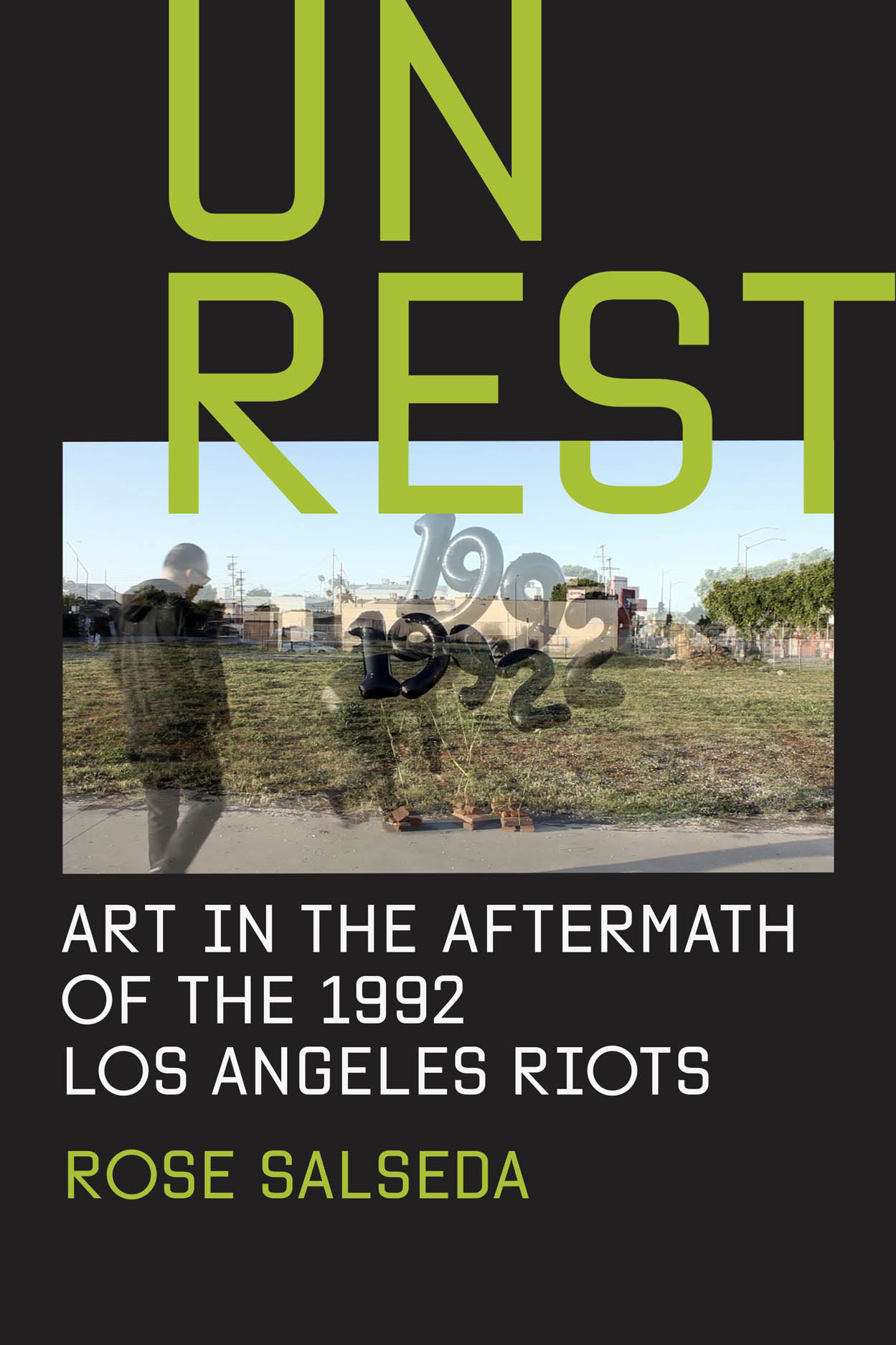
Unrest
Art in the Aftermath of the 1992 Los Angeles Riots
Unrest
Art in the Aftermath of the 1992 Los Angeles Riots
The first book to examine the visual art legacy of the 1992 Los Angeles Riots.
On April 29, 1992, a jury’s acquittal of four white Los Angeles police officers who had beaten Rodney King, a Black man, incited five days of intense protests. The 1992 Los Angeles Riots resulted in nearly four thousand fires, over $1 billion in property damage, fourteen thousand arrests, two thousand injuries, and sixty-three deaths. While many scholars have studied the period leading up to and following the riots, few have focused on how contemporary artists reacted to and continued to respond to this traumatic event.
In Unrest, Rose Salseda provides the first major art historical account of the 1992 Los Angeles Riots that chronicles the works of two generations of artists. Closely examining visual art that explores overlooked cross-racial, immigrant, and intergenerational experiences of the events, Salseda provocatively frames unrest as an act of the bereaved that makes visible the unrelenting experiences of injustice. She provides important insights into how we process violence through imagery; how the criminal justice system visualizes race and tolerates racial and xenophobic violence; and how we adapt racialized modes of viewing, normalize violence and oppression, and perhaps unwittingly contribute to these injustices. Ultimately, Unrest highlights how the experience of the 1992 Los Angeles Riots has driven artists to address the King beating and related episodes of racial violence for over thirty years—underscoring unrest as the inability to rest in the face of state-sanctioned violence, which persists to this day.
256 pages | 52 halftones | 6 x 9 | © 2026
Art: American Art
History: American History, General History
Reviews

Table of Contents
Excerpt
Chapter 4: Vision in Ruins
“From the Future, I See It”
During the last segment of Latipa’s three-channel video installation Civil Society (2008), a cityscape darts across the window of a moving train. The blur of buildings and other structures moves across the three screens in sequence, but each image is slightly delayed, making it more difficult for my eyes to focus on the fast-moving footage. So instead I shift my attention to Latipa’s soft-spoken narration. Over the quiet rumble of the train, she reflects on the past fifteen years since the 1992 Los Angeles Riots, struggling to understand herself within the discord of declarations she has internalized. From the claim, “We have healed, we have mourned, we have moved on,” to attempts that try to differentiate “those people” from “us” and “us from them,” and finally to the appeals she should make in light of this history and her positionality as “a woman of color, the child of immigrants, issued out of colonialism,” I hear the frustration, anxiety, and pain. Then, with unexpected clarity, she explains, “Fifteen years have passed, and I see ruins. The ruins have nothing to do with cities, structures, streets, fire, ashes, smoke, hints of an orange sky. The ruins are myself. Part of myself, I leave for the wind. I am in ruins.” With these last words, my vision blurs with tears. Latipa continues with certainty, “1992, Los Angeles. There is in fact nothing to see.” Nothing but also everything: our memories and experiences of unrest. As my tears further dissolve the cityscape into a haze of sorrow, childhood memories of violence and death take shape.
I remember my mother kneeling over a teenage boy as she desperately tries to stop blood from spilling out of the bullet wounds that ruptured his body. His bike lays beside him on its side and the tire spins. With a rush of confusion, so does my head once I realize that the crowd gathered around us is unwilling to help. Is it the shock of seeing someone dying that freezes them in place? Or is it the sight of an African American in our Latino neighborhood? My heart races. I cannot breathe. His death marks the moment I realized how Black people, even children, are especially vulnerable to hostility and cruelty. I then remember the video of police beating Rodney King. They hit him, over and over, as he repeatedly tries to crawl away. But he cannot escape. Evidence of the disproportionate brutality that Black Americans experience was not enough to convince a jury to convict King’s uniformed white and Latino attackers. The crowds chant outside the courtroom, “No justice! No peace!” We then take cover from the bullets being shot outside our home. With my face pressed against the rough brown fibers of the carpet in my grandmother’s living room, I watch live news coverage of lootings and beatings morph into panoramic views of our neighborhood engulfed in flames. Thick plumes of smoke rise into the sky, and my throat burns as I struggle against the visceral response to weep. I am in ruins. These words echo over and over in my head along with memories of the dead and beaten. I am in ruins.
I am in ruins I
am
in
ruins
Then, from the unrest, I hear Latipa’s voice: “To remain looking toward the past would mean to let this past die. And no, every part of me says, it must live on.” I can no longer hold back the tears. As they silently fall, my blurred vision clears, and suddenly I can see even though the city is still distorted and out of sync. With the sound of the train wheels hitting the tracks like a steady heartbeat, Latipa concludes, “You tell me, you understand, I’ve created a space to grieve.” I am in ruins. But from ruins our unrest and grief can drive us forward—it must because, as Latipa poignantly promises, this is how what has been lost can live. It is then, from the future, I see it: the embrace of our roles as the ruins of so-called civil society, undermining, demanding, and seeing to the end of racial violence, xenophobia, and oppression. “Civil society” is a vision in ruins, a monument already and always in decline. And ours is a vision of ruins—ruin-nation: the unrest that recognizes the end as beginning.