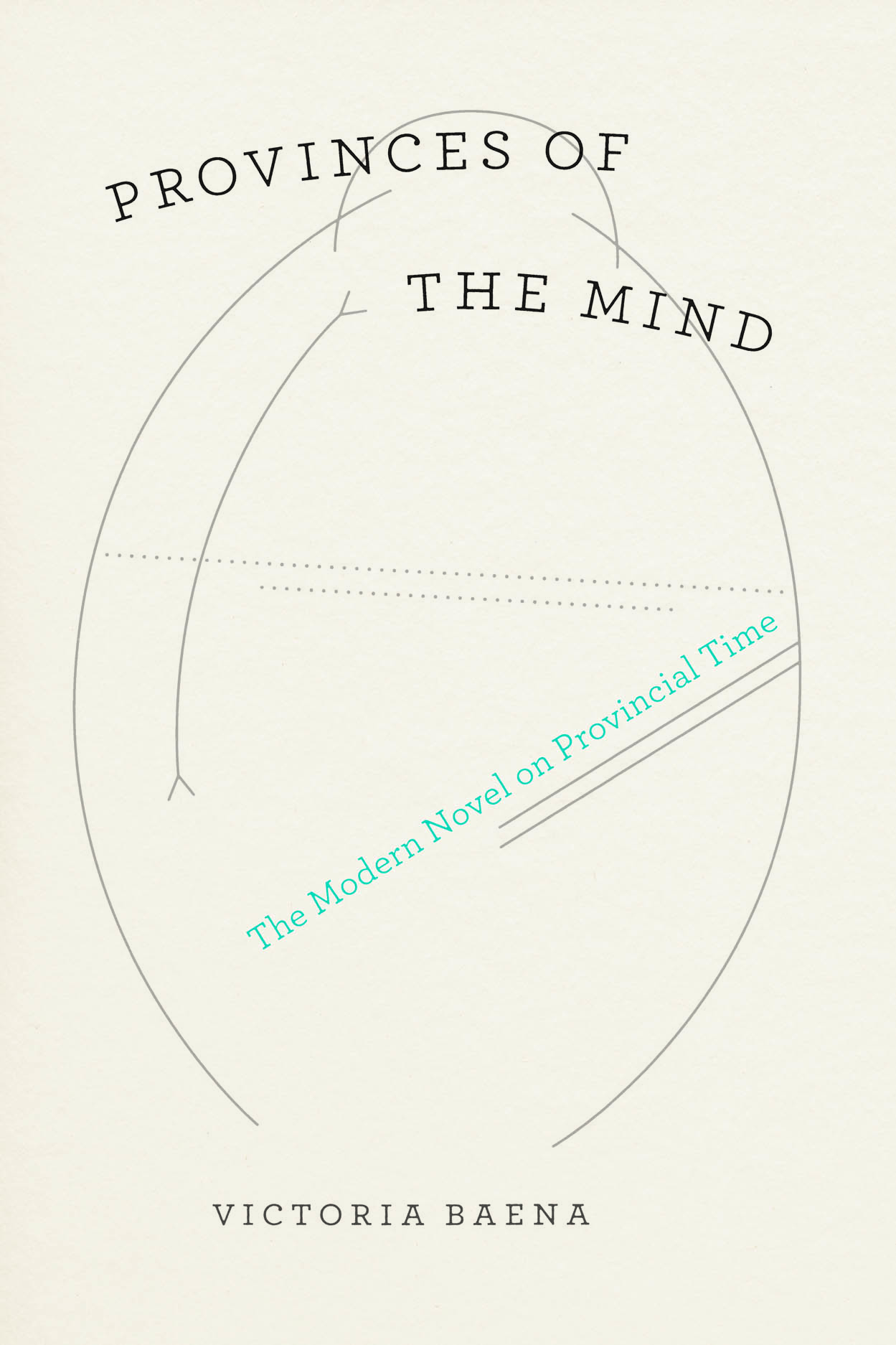
Provinces of the Mind
The Modern Novel on Provincial Time
Provinces of the Mind
The Modern Novel on Provincial Time
How the provinces, rather than cities or capitals, became the key setting dramatized in—but also transformed by—modern novels in English and French.
To be provincial is to mistake one’s narrow milieu for the world: it is to fall prey to an error of scale. But it is also to feel behind, belated, and excluded from the possibilities of the modern world. In this elegant study of the novel “on provincial time,” Victoria Baena argues that the literary geography of “the provinces” played a key role in forging European narratives of modernity.
In the wake of French revolutionaries’ suppression of older provincial identities and as Britain expanded its imperial reach, the provinces were reinvented on various scales: from countryside to small town, from domestic region to faraway colony. Baena brings together Marxist and feminist spatial theory with close attention to the politics of narrative form in order to show how the remarkably mobile concept of the provinces developed across social and cultural frameworks from 1800 to 1933. Offering new interpretations of novels of the realist tradition—by Honoré de Balzac, George Eliot, Emily Brontë, George Sand, Thomas Hardy, Marcel Proust, Alain-Fournier, James Joyce, and Claude McKay—she shows how the question of representing the provinces transformed the modern novel.
Provinces of the Mind illuminates some of the more pernicious fictions of provincialism. But it also describes, often movingly, the desire no longer to be provincial, along with the ambivalence and alienation that can entail. Ultimately, the book shows how literary critics can use the provinces to translate questions of literary geography across borders. By interrogating the provincialisms of our own time and place, Baena suggests, critics might make a better case for those worth retaining and have a better grasp of those to be left behind.
304 pages | 8 halftones | 6 x 9 | © 2027
Literature and Literary Criticism: British and Irish Literature, Romance Languages
Reviews

Table of Contents
List of Figures
Introduction
Overture. The Politics and Aesthetics of Revolutionary Cartography
Chapter One. Melancholy Mediations: Balzac’s Provincial Readers
Chapter Two. Political Geography, Provincial Vernaculars, and the Novel of 1848
Chapter Three. Pastoral Vagrancy, Provincial Picaresque
Chapter Four. Hardy’s Middle Distances, from Wessex to Brazil
Chapter Five. Mourning for the Provinces
Chapter Six. Modernist Provinces, Anticolonial Pastoral
Conclusion. Cosmopolitan Provincialism
Acknowledgments
Notes
Bibliography
Index