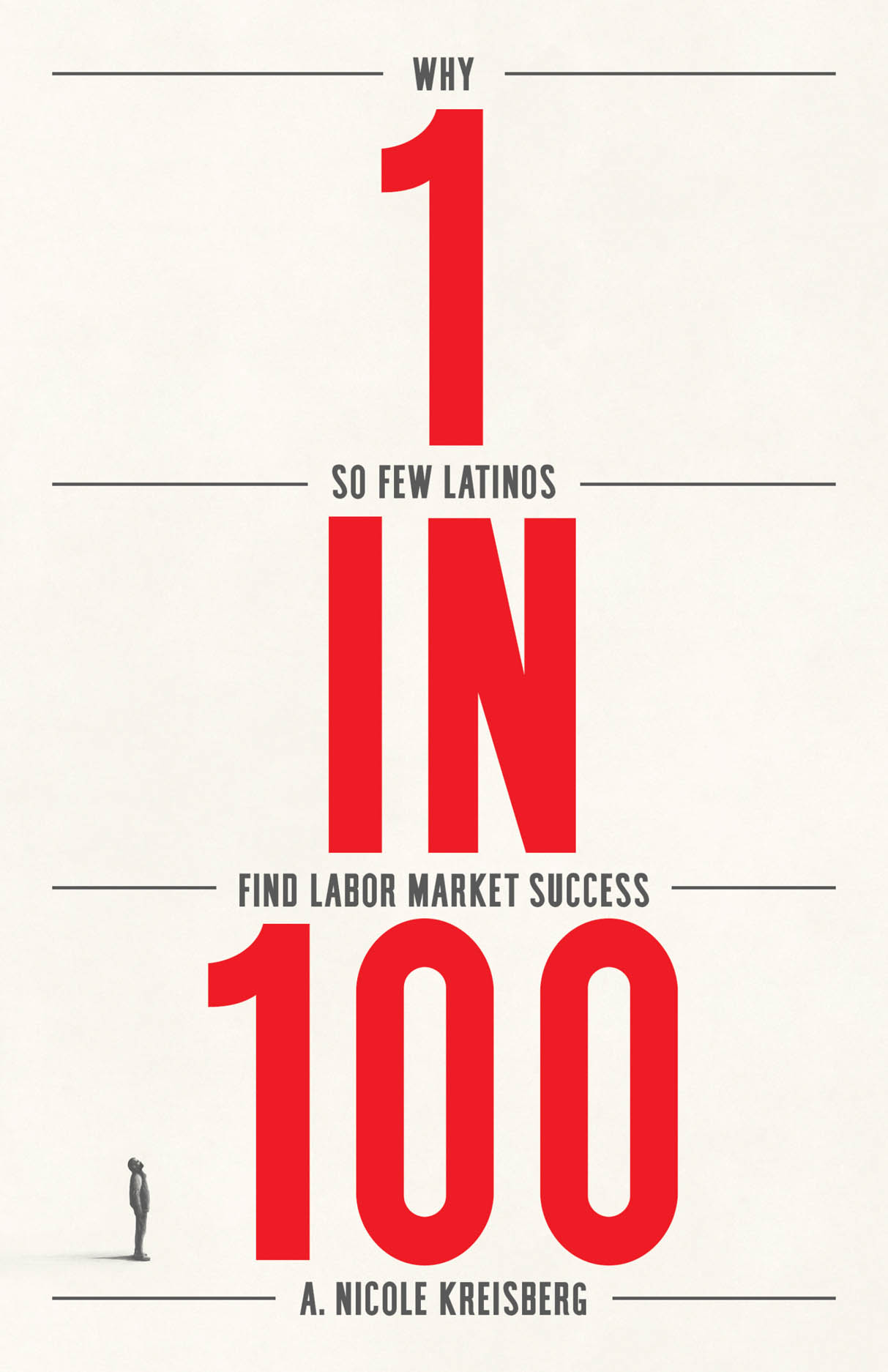
1 in 100
Why So Few Latinos Find Labor Market Success
1 in 100
Why So Few Latinos Find Labor Market Success
A behind-the-scenes look at why Latinos—the largest immigrant group in the United States—make up a staggeringly low percentage of the elite US labor force.
Carla, Douglas, and Isabel each migrated to the United States from Latin American countries before they were teenagers. Each had big dreams—in medicine, business, and government—and each did what they were told to do to achieve their goals: work hard, stay in school, and follow the rules. Yet none of them reached the top of the labor market, and they are far from alone. Only one out of one hundred Latino immigrants who arrives in the United States as children will ever secure a job that requires a college degree and pays high wages.
In 1 in 100, sociologist A. Nicole Kreisberg explains why Latinos are more likely to have difficulty finding success in the labor market. Despite increasing access to higher education, Latino immigrant youth seldom land high-paying jobs, but not because of individual failure. Instead, these slim odds are the result of immigration laws, schools, and workplaces that interact in ways that systematically disadvantage so many Latinos. Kreisberg finds that stereotypes about Latino immigrants are activated in US schools, exacerbated in US colleges, and reinforced by employers’ hiring decisions. And because most Americans cannot tell who is and who isn’t an immigrant, the stereotypes harming immigrants often spill over to the 68 million Latinos living in the United States, including those who are US citizens.
By tracing the school-to-work trajectories of child-arriving Latino immigrants and native-born Latinos, alongside the gatekeepers who structure their opportunities, 1 in 100 shows that the 99 who struggle are not the exception—they are the unfortunate norm.
272 pages | 7 halftones, 3 line drawings, 3 tables | 5 1/2 x 8 1/2 | © 2027
Sociology: Individual, State and Society, Occupations, Professions, Work, Race, Ethnic, and Minority Relations, Social Organization--Stratification, Mobility
Reviews

Table of Contents
1. 1 in 100: From Possible to Improbable
Part 1. Education
2. Counted Out in the Classroom: How Teacher Stereotypes Cut 100 into 61
3. When Organizations Intervene: The College Context Converts 61 into 13
Part 2. The Labor Market
4. Written Off at Work: Employer Stereotypes Resurface to Slash 13 into 3
5. Exclusion from the Elite: The Company Context Reduces 3 to 1
6. Expanding the Odds Beyond 1 in 100
Epilogue
Acknowledgments
Methodological Appendix
Notes
References
Index