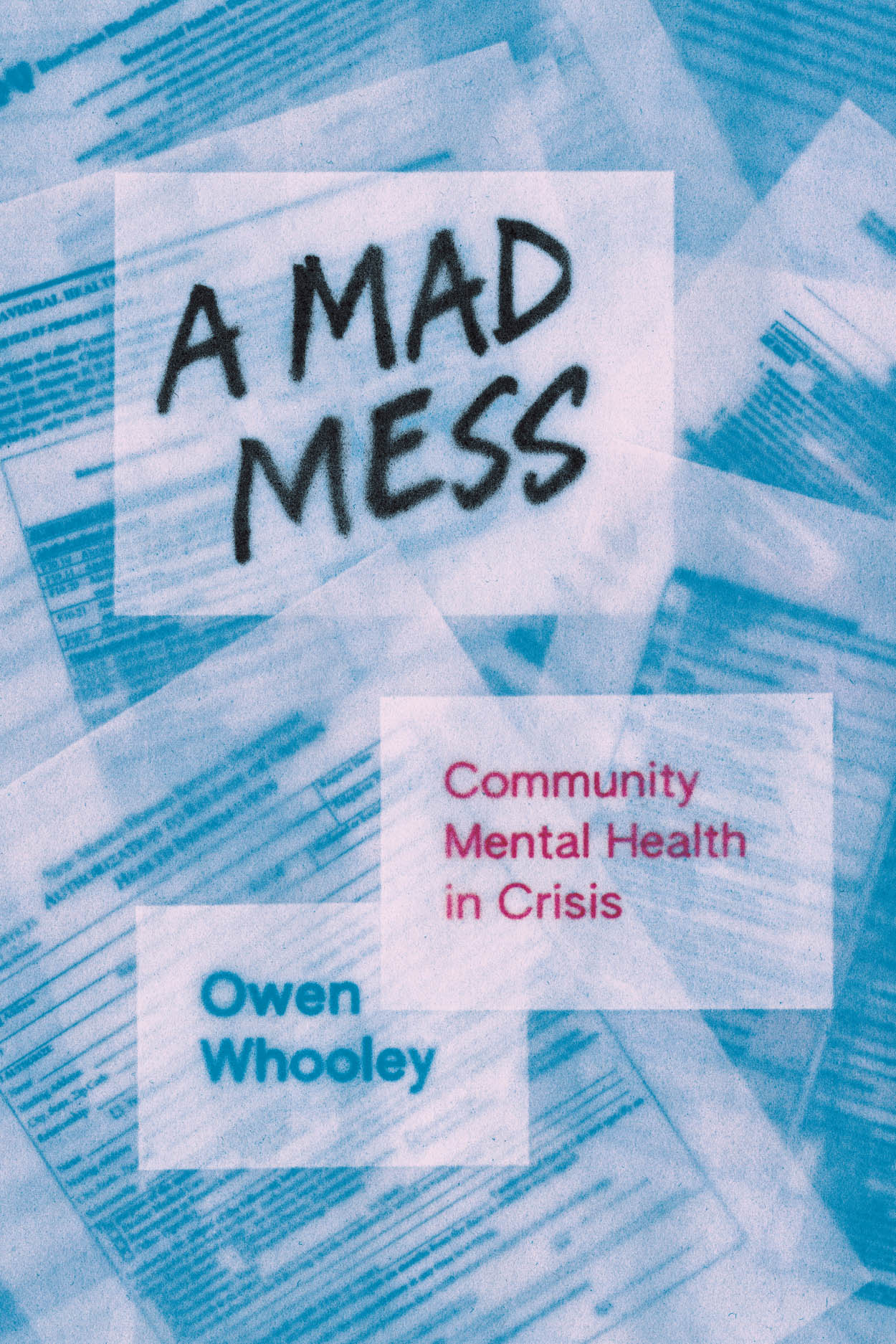
A Mad Mess

Community Mental Health in Crisis

A Mad Mess

Community Mental Health in Crisis

A sobering assessment of the systematic failures of mental health work.

The United States is in the midst of a mental health crisis that cannot be ignored. Its effects are visible in overcrowded emergency rooms, homeless encampments, and frequent police encounters responding to people with serious mental illness. And yet, the many ways we attempt to support people with mental illness—from medical care to housing support to basic hygiene—seem to never take meaningful hold. All this despite the tireless work of professionals who attempt to help people bring together the pieces of a life. The problem is not in any individual effort to ameliorate the problem; it’s the many ways these programs fail to work together. For those with serious mental illness, and those who work to ameliorate it, there is no system. There is only mess. 

In A Mad Mess, sociologist Owen Whooley uncovers the exasperating barriers, bureaucratic mismatches, and threadbare resources that have made a mess of what should be a supportive system. Set in Albuquerque, New Mexico—a city whose struggles echo communities nationwide— the book reveals the challenges mental health workers face daily, from tedious paperwork to occasional violence. Whooley interviewed mental health workers at two local mental health services organizations, the specialized behavioral health division of the Albuquerque Police Department (APD), and a psychiatric emergency department at the University of New Mexico Hospital. Despite mostly good intentions and sometimes heroic efforts, he shows why this important work so often ends in failure. 

Written with deep sympathy and unflinching honesty, A Mad Mess reveals how the lack of a cohesive mental health system obstructs critical care and places roadblocks before front-line mental health workers at every turn. Most critically, for those who suffer from severe mental illness, these setbacks are a constant reminder that the institutions charged with helping them have left them on their own.

Reviews

Owen Whooley’s timely book provides an in-depth view of the current crisis in community mental health care. His ethnography illuminates one of the most persistent, complex, and challenging social problems of our time. Anyone who is concerned with the difficulties confronting persons with serious mental illness and the thoroughly inadequate social responses to their problems needs to read this book.

Allan V. Horwitz, author of 'Between Sanity and Madness: Mental Illness from Ancient Greece to the Neuroscientific Era'

“By stepping outside of the clinic and into the backseats of police cruisers, corridors of emergency rooms, and decrepit housing complexes, Owen Whooley gives us perhaps the most accurate look yet at what ’care’ actually looks like for people with the most serious mental illnesses in the United States today. Recognizing his disturbing conclusion - that community mental health is too fragmented, under-resourced, and leaderless to qualify as a ’system’ - is a first step for getting ourselves out of this mess.”

Alex V. Barnard, author of 'Conservatorship: Inside California’s System of Coercion and Care for Mental Illness'

In A Mad Mess, the great historical chronicler of psychiatry Owen Whooley turns his gaze to the present-day failings of American mental health care and offers a new way to think about the “system.” Drawing on extensive fieldwork with street outreach, police, and emergency care, he convincingly shows that the disconnected pieces do not amount to a system at all. This compelling portrait of the world-as-it-is will be eye-opening to policymakers, practitioners, patients, and concerned citizens alike. 

Neil Gong, author of 'Sons, Daughters, and Sidewalk Psychotics: Mental Illness and Homelessness in Los Angeles'

Table of Contents

Introduction

Part I: Work
1. Policing Mental Health
2. Psychiatric Emergency Medicine
3. Care—and Coercion—in the Community

Part II: Mess
4. Heroic Paperwork
5. Dirty Work and Violence
6. Failure and Persistence

Conclusion

Acknowledgments
Appendix: Methodological Reflections
Notes
Selected References
Index

Be the first to know

Get the latest updates on new releases, special offers, and media highlights when you subscribe to our email lists!

Sign up here for updates about the Press