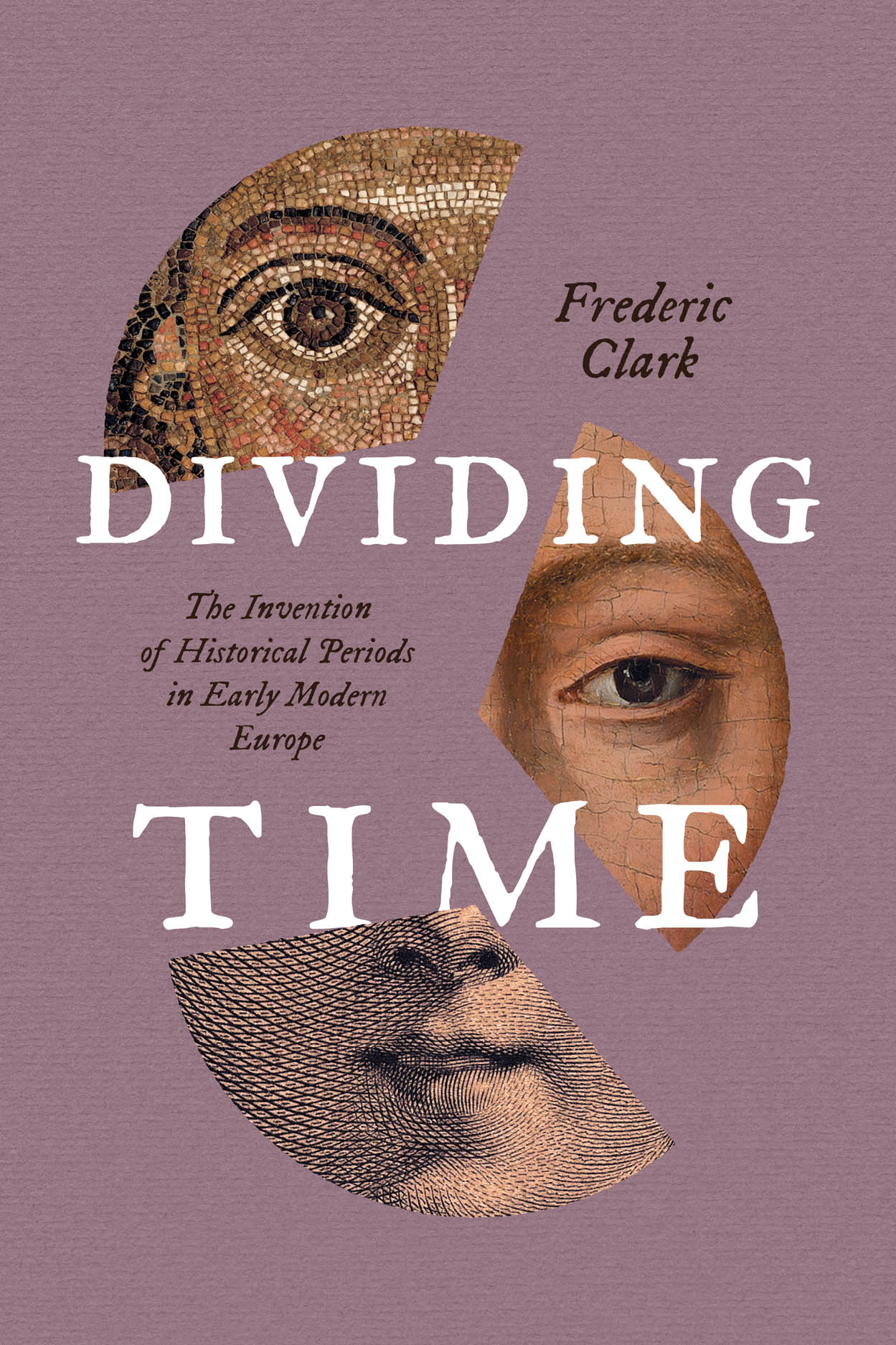
Dividing Time
The Invention of Historical Periods in Early Modern Europe
Dividing Time
The Invention of Historical Periods in Early Modern Europe
A bold reconstruction of the origins of the “ancient, medieval, modern” trope used to define historical eras and the transitions between them.
We are used to dividing time, indicating the beginning or end of an era based on a year, a month, or even a specific day, after which (supposedly) “nothing was the same.” In this book, historian and classicist Frederic Clark looks at a particularly enduring form of dividing time—the tripartite distinction between antiquity, the Middle Ages, and modernity—in order to analyze the history of this division, how it has been constructed and deployed, and what its past and present implications are.
Clark argues that the study of the past has always depended on subdividing it into multiple parts, which tend to underpin any attempt to articulate a system of culture or value. After all, certain eras, ages, and epochs are celebrated as having ushered in a new, better time, whereas others are depicted as extended periods of decay and darkness. Clark provides an ingenious critique of the foundational assumptions underlying our narratives of periodization and the complex and messy process by which historical schemas develop, from the Renaissance through the early modern period to the Enlightenment and beyond. The result is an engaging and erudite tour through time and its many contested divisions, imagined and reimagined across history.

Table of Contents
Note to Readers
Introduction: Why Divide Time? A Present Quandary and Its Past
Chapter One. Medieval Modernities: The Ambiguous Origins of Tripartite Periodization
Chapter Two. New Narratives: The Origins of Decline and Fall
Chapter Three. New Terms (I): The Origins of the Classical and the Medieval
Chapter Four. New Terms (II): The Career of the Classical and the Medieval
Chapter Five. The Order of Books (I): Bibliographies and Encyclopedias
Chapter Six. The Order of Books (II): Histories and Chronicles
Chapter Seven. Beyond Antiquity? The Scholarly Turn to Lateness
Chapter Eight. Polychronic Periodizations: Dividing Time in the Seventeenth Century
Chapter Nine. Canonizing the Ancient/Medieval/Modern
Chapter Ten. Periodizing the Enlightened Narrative
Epilogue: Periodization Between Triumphalism and Defeatism
Acknowledgments
Notes
Bibliography
Index